-
Written By Khushboo Maurya
-
Updated on August 12th, 2026
How to Open or Remove Encryption from Outlook Emails (2026 Guide)
Quick answer: When you receive an encrypted email in Outlook, that doesn’t mean something is wrong. In most cases, Outlook protects the message through either Microsoft 365 Message Encryption (OME) or S/MIME encryption. If you can’t open the email, you usually need to sign in with the correct account or verify your identity using a one-time passcode. If your goal is to remove encryption from a message, Outlook allows this only in specific situations and mainly for S/MIME-protected emails.
It’s also important not to confuse encrypted emails with password-protected PST files. They are completely different issues and require different solutions.
Which “Encrypted Email” Problem Do You Have?
| 1. I can’t open a message someone sent me The message asks you to sign in or verify your identity with a one-time passcode. This is Microsoft 365 Message Encryption (OME). |
2. I want to remove encryption from a message You received or composed an S/MIME encrypted message and want to strip the encryption to save or forward it. |
3. A .pst file asks for a password Outlook works, but a saved data file won’t open. That’s a file password, not message encryption. |
Why are Outlook Emails Encrypted?
Email encryption protects sensitive information while messages travel across the internet. Email encryption protects sensitive information such as financial records, legal documents, and internal business communications. Only the intended recipient can view the contents.
Microsoft Outlook mainly supports two encryption technologies.
| Encryption Type | Used For | Authentication |
| Microsoft 365 Message Encryption (OME) | Secure external communication | Microsoft account or one-time passcode |
| S/MIME | End-to-end encrypted corporate emails | Digital certificates |
Two Kinds of Email Encryption – Know Which One You’re Facing
Before you touch any setting, identify which encryption is in play, because the fixes don’t cross over.
| Microsoft 365 Message Encryption (OME) | S/MIME | |
| What it protects | A single sent message and its reply chain | A single message, using certificates |
| How you open it | Sign in as the recipient, or use a one-time passcode | Automatically, if your certificate is installed |
| Set up by | The sender’s organization | Sender and recipient certificates |
| You need | Access to the recipient’s inbox | Your private key on the device |
How to Open a Microsoft 365 Encrypted (OME) Email
A message protected by Microsoft 365 Message Encryption opens only for the address it was sent to. If Outlook won’t display it, use the message’s “Read the message” link and verify with a one-time passcode. This is the single most common “I can’t open an encrypted email” case, and no third-party software is involved; access is controlled by Microsoft.
- In Outlook or Outlook.com: if you’re signed in with the exact address the message was sent to, open it; protected messages decrypt automatically once you’re authenticated.
- In any other mail client (Gmail, Apple Mail, a work address): open the message and click Read the message. It opens Microsoft’s secure viewer in your browser.
- Choose Sign in with the account the message was sent to, or select Sign in with a one-time passcode.
- Microsoft emails a temporary passcode to that same inbox. Enter it in the browser to read the message.
Official steps: Microsoft — How do I open a protected message?
If your encrypted email doesn’t use Microsoft 365 Message Encryption (OME), it may be protected with S/MIME instead. Unlike OME, S/MIME relies on digital certificates rather than account verification or one-time passcodes.
How to Read an S/MIME Encrypted Message?
S/MIME messages are encrypted to your certificate, so they open on their own if the certificate and its private key are installed on the device you’re reading from. If Outlook shows the message but can’t display the body, the usual cause is a missing or expired certificate.
- Confirm your S/MIME certificate is installed: File > Options > Trust Center > Trust Center Settings > Email Security.
- Under Encrypted email, check that a valid certificate is listed under Settings.
- If it’s missing or expired, reinstall or renew it; the same certificate the message was encrypted with must be present.
- Restart Outlook and reopen the message.
Reference: Microsoft — S/MIME and secure messages in Outlook.
How to Remove Encryption from an Outlook Email
Sometimes users need to save an email without encryption before forwarding or archiving it. This applies mainly to S/MIME messages.
Method 1: Remove Encryption While Composing
If you’re composing a new email, you can remove encryption before sending it. Open the email >> Select Options >> Click Encrypt >> Select Do Not Encrypt >> Send the email.
Method 2: Remove Encryption from a Received Message (Administrator Only)
Sometimes you need a plain, unencrypted copy of a message; to archive it, forward it to a system that can’t read S/MIME, or store it outside Outlook. In classic Outlook, this needs an administrator-level registry change, because by default Outlook won’t let you strip protection from a received message.
Admin action, use with care. This edits the Windows registry and should only be done by, or with, an IT administrator, and only on messages you are authorized to access. Back up before editing.
- Open Registry Editor (Win + R → regedit).
- Go to HKEY_CURRENT_USER\SOFTWARE\Policies\Microsoft\Office\16.0\Outlook\Security (16.0 = Outlook 2016/2019/2021/365).
- Create a DWORD value named AllowRecvMsgDecryption and set it to 1.
- Restart Outlook. Open the message, then File > Info > Properties, uncheck Encrypt message contents and attachments, and save.
For most people, this is overkill. If you only need to read the message, open it normally with the methods above and leave the encryption intact; it protects you as much as the sender.
Common Errors that Can’t Open Encrypted Email
| What you see | Cause | Fix |
| “This message is protected,” and nothing happens | Signed in with the wrong accountx | Use the Read the message, one-time passcode to the recipient address |
| Passcode never arrives | Filtered to Junk, or wrong inbox | Check the spam folder of the exact address the message was sent to |
| Body is blank on an S/MIME message | Missing or expired certificate | Reinstall/renew your S/MIME certificate, then reopen |
| Attachment won’t open after decrypting | Rights-management still applied | Open in the same signed-in Outlook session; don’t save-then-open externally |
If Outlook Is Asking for a Password on a .pst File – That’s Different
One case that gets mixed up with encrypted email: Outlook prompting for a password when you open a data file (.pst). That isn’t message encryption at all; it’s a password stored inside a local file, and none of the methods above apply. You need to remove or recover the password from the PST file itself. See the dedicated guide: how to remove a password from a PST file, which walks through doing it with Cigati PST Password Remover when the password is lost.
Steps to Access Password in Outlook
- Download and run the Cigati PST Password Remover and run it as an administrator.
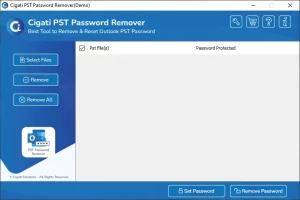
- Add the healthy or encrypted Outlook PST file.
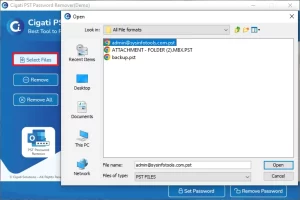
- Choose the PST file whose password you wish to decrypt.
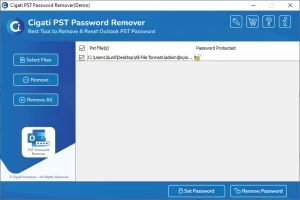
- Click on the Remove Password button.
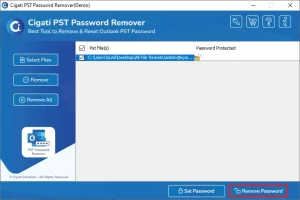
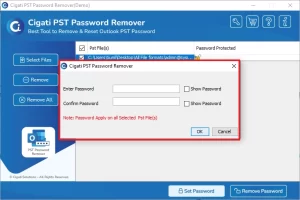
- Enter the password again in your selected PST file (optional).
Difference Between Encrypted Emails and PST Passwords
Most of the users think that Outlook encryption and PST Passwords are the same, but in reality they are both different.
| Encrypted Email | Password-Protected PST |
| Protects one email | Protects Outlook data file |
| Controlled by sender | Controlled by PST password |
| Uses OME or S/MIME | Uses Outlook PST encryption |
| Opens after authentication | Requires PST password |
If Outlook asks for a PST password, then none of the methods above will work. You must remove or recover the PST password separately.
Wrap Up
Most “I can’t open an encrypted email in Outlook” problems come down to identity: the message was locked to a specific inbox, and the one-time passcode flow is how you prove you own it. S/MIME issues are almost always a certificate that’s missing or expired. Removing encryption is an admin-level step you rarely need. And if the password prompt is really on a .pst file, that’s a separate fix entirely; start with the PST password guide.
Frequently Asked Questions
Q1. Why can’t I open an encrypted email someone sent me in Outlook?
Ans. Microsoft 365 encrypted emails can only be opened by the email address they were sent to. If you’re signed in with a different account, Outlook won’t decrypt the message. Sign in using the correct recipient account or click Read the message and verify your identity with a one-time passcode. For S/MIME messages, ensure your digital certificate and private key are installed on your device.
Q2. Can I open an encrypted Outlook email without Outlook or a Microsoft account?
Ans. Yes. If the message is protected with Microsoft 365 Message Encryption (OME), you can open it in any web browser by clicking the Read the message link in the email. Choose the one-time passcode option, enter the verification code sent to your inbox, and the message will open securely without requiring Outlook or a Microsoft account.
Q3. How do I remove encryption from an Outlook email?
Ans. If you’re composing a new email, go to Options > Encrypt and select Do Not Encrypt before sending. For a received S/MIME encrypted email, Outlook doesn’t normally allow removing encryption. An administrator can enable this by adding the AllowRecvMsgDecryption registry value, after which the message can be saved without encryption if permitted by your organization’s policies.
Q4. Do I need the sender’s certificate to read an S/MIME encrypted email?
Ans. No. You only need your own valid S/MIME certificate and its associated private key because the message is encrypted using your public key. If your certificate is missing, expired, or unavailable on the device, Outlook won’t be able to decrypt the message until the certificate is restored or renewed.
Q5. Why does Outlook show a blank encrypted email?
Ans. A blank encrypted email usually indicates that Outlook cannot decrypt the message. This commonly happens when your S/MIME certificate has expired, the private key is missing, or you’re opening the email on a device where the certificate isn’t installed. Installing the correct certificate and restarting Outlook generally resolves the issue.
Q6. Is Microsoft 365 Message Encryption the same as S/MIME?
Ans. No. Microsoft 365 Message Encryption (OME) secures emails by verifying the recipient’s identity through Microsoft sign-in or a one-time passcode. S/MIME uses digital certificates installed on both the sender’s and recipient’s devices to provide end-to-end encryption and digital signatures. Although both protect email content, they use different authentication methods.
Q7. What is the difference between an encrypted email and a password-protected PST file?
Ans. An encrypted email protects the contents of a single message while it’s being sent and received using technologies such as Microsoft 365 Message Encryption or S/MIME. A password-protected PST file, on the other hand, secures an Outlook data file stored on your computer. These are separate security mechanisms, and solving one issue won’t affect the other.
Q8. How do I open a PST file if I forgot its password?
Ans. A forgotten PST password cannot be bypassed by Outlook itself. If you no longer remember the password, you’ll need a reliable PST password recovery or removal tool to regain access to the data file. Once the password is removed or recovered, you can open the PST normally in Outlook without affecting the emails stored inside.
About The Author:

Khushboo Maurya is a digital content and SEO professional focused on creating useful, search-friendly content that connects with the right audience. She specializes in content optimization, website growth, and practical SEO strategies that improve visibility, engagement, and organic reach.
Related Post